Airbyte vs Informatica: open-source EL or enterprise data management?
Data Integration
Airbyte vs Informatica: open-source EL or enterprise data management?
Open-source EL with volume-based pricing vs. enterprise data management with opaque licensing. Both require a warehouse.
What Airbyte and Informatica do as data platforms
Both move data from sources into warehouses. They differ in era, complexity, and cost: open-source flexibility vs. enterprise data management breadth.

Airbyte
Airbyte is an open-source data integration platform founded in 2020. It extracts data from SaaS apps, databases, and files, then loads it into warehouses or databases. The platform lists 600+ connectors across Certified and Community tiers. It runs as a cloud service or self-hosted on your own infrastructure, giving engineering teams control over deployment and sync frequency.

Informatica
Informatica has built data integration tools since 1993, starting with PowerCenter, now its legacy on-premises product. The line spans integration, data quality, governance, master data management, and cloud services. Salesforce closed its acquisition on November 18, 2025, so Informatica is now part of Salesforce, inside Salesforce Data Cloud. It serves primarily Fortune 500 companies.
Airbyte vs Informatica feature and pricing comparison
How they compare on connectors, pricing, latency, scalability, and the architectural choices that shape your data stack.
Airbyte
Informatica
Primary approach
Open-source EL (extract, load). Transforms via dbt in the warehouse.
Enterprise data management suite: integration, quality, governance, MDM.
Connector count
600+ listed across Certified and Community tiers
300+ enterprise connectors including on-premises and mainframe
Pricing model
$10/GB database, $15/M rows API. Free open-source edition.
Opaque 'Informatica Pricing Units' based on compute hours. Quote required.
Set up time
Self-hosted, cloud, or hybrid on one codebase
On-premises, private cloud, public cloud with managed data plane
Deployment options
1 hour on Cloud, 5 minutes self-hosted. Batch only.
Sub-second CDC via PowerExchange. Streaming and batch supported.
Minimum sync latency
dbt Cloud integration only. No in-flight transforms.
Visual ETL in Cloud Data Integration (legacy PowerCenter on-prem), pushdown.
Open-source availability
Yes. Full self-hosted deployment with source code access.
Yes. Full self-hosted deployment with source code access.
Built-in data quality
No. Requires external tools for data quality and governance.
Profiling, cleansing, master data management, and governance included.
Scalability
Limited. Single-worker extraction. Memory-bound at high volumes.
Enterprise scale. Serverless compute, pipeline partitioning.
Company status
Independent, VC-backed. Founded 2020.
Part of Salesforce (merger closed Nov 18, 2025). Founded 1993.
Strengths and limitations
Airbyte
Informatica
Open-source with full source code access
Deploy on your infrastructure, audit the codebase, and avoid vendor lock-in. The self-hosted edition removes Cloud's 1-hour sync limit, dropping intervals to 5 minutes.
Broadest enterprise data management suite
Integration, data quality, governance, and master data management in one platform. If your needs grow beyond data movement, the tooling is already there without adding vendors.
Predictable volume-based pricing
Airbyte charges $10/GB for databases and $15/M rows for APIs. The open-source edition runs free on your servers. Unlike Informatica's opaque compute-unit billing, costs are easy to forecast.
Sub-second latency at enterprise scale
PowerExchange CDC delivers sub-second replication. Serverless compute and pipeline partitioning handle large deployments without the scaling ceilings that constrain lighter-weight tools.
AI-assisted custom connector builder
The CDK and no-code builder let teams create connectors for niche sources in hours. Over 1,000 community contributors have added connectors beyond Airbyte's Certified tier.
Private cloud and hybrid deployment
A managed private data plane gives SaaS convenience with data residency control. Regulated industries with strict compliance requirements get deployment flexibility that cloud-only tools cannot offer.
Batch-only processing
Airbyte Cloud syncs hourly at best. Self-hosted gets 5-minute intervals, but there is no native streaming. If your use case needs sub-minute data freshness, Airbyte cannot deliver it.
Opaque, expensive pricing
'Informatica Pricing Units' vary by workload type with separate compute-hour and row-based CDC charges. Every plan requires a sales quote. Expect significantly higher costs than most alternatives.
Variable connector quality
Connectors split into Certified and Community tiers, and Community ones vary in reliability. Single-worker extraction means memory limits can cause failures under heavy loads.
Steep learning curve
Even Informatica Cloud requires weeks of onboarding. Multiple products with separate interfaces, concepts, and deployment models add complexity. Teams without prior experience need formal training.
Our Suggestions
Choose Airbyte if you need open-source control, self-hosting, and predictable per-GB pricing for warehouse-centric data loading.
Choose Informatica if you need enterprise-scale data management with governance, data quality, sub-second CDC, and private cloud deployment.
Neither one of them feels right to you?
If you just need SaaS tools sharing customer data — warehouse optional — Oneprofile syncs tools directly with published pricing, self-serve signup, and no batch pipeline to manage.
How Oneprofile fills that gap
Direct tool-to-tool sync with published pricing, self-serve signup, and warehouse optional. Most teams are live in minutes, not months.
Difference 1
Warehouse optional
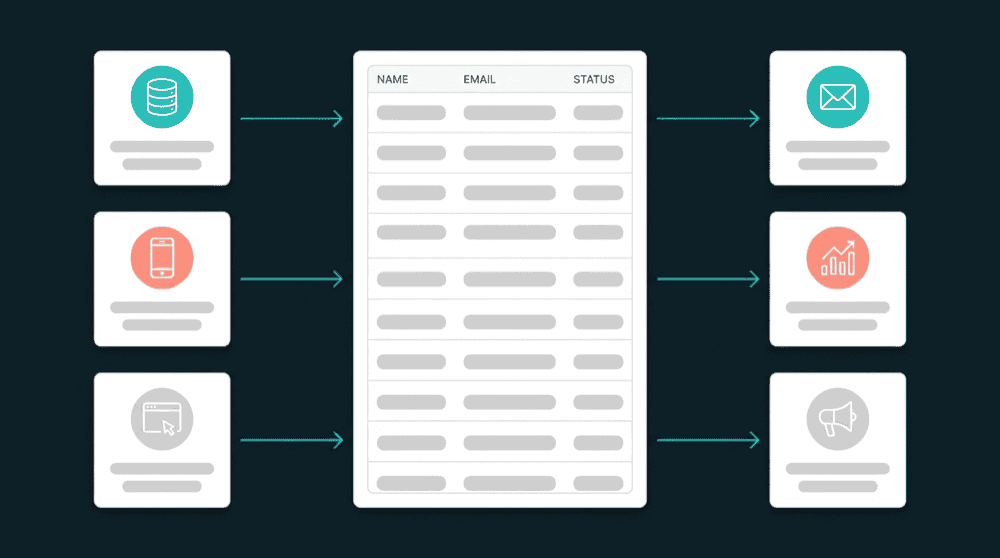
Airbyte and Informatica both load data into warehouses. Getting that data back into your CRM or marketing platform requires a separate reverse ETL step. Oneprofile works with or without a warehouse. Connect your database or any SaaS tool, map fields to a destination, and data syncs on the schedule you choose. No mandatory warehouse compute costs, no dbt models, no second pipeline.
Difference 2
Published pricing at every tier
Informatica's pricing units require a sales call and a calculator to decode. Airbyte's per-GB model is clearer but still requires estimating monthly data volume. Oneprofile publishes every plan on the website: free to start, $100/mo Team, $2,000/mo Enterprise. Pay through Stripe checkout. No consumption credits, no compute units, no surprise invoices.
Difference 3
Bidirectional sync by default
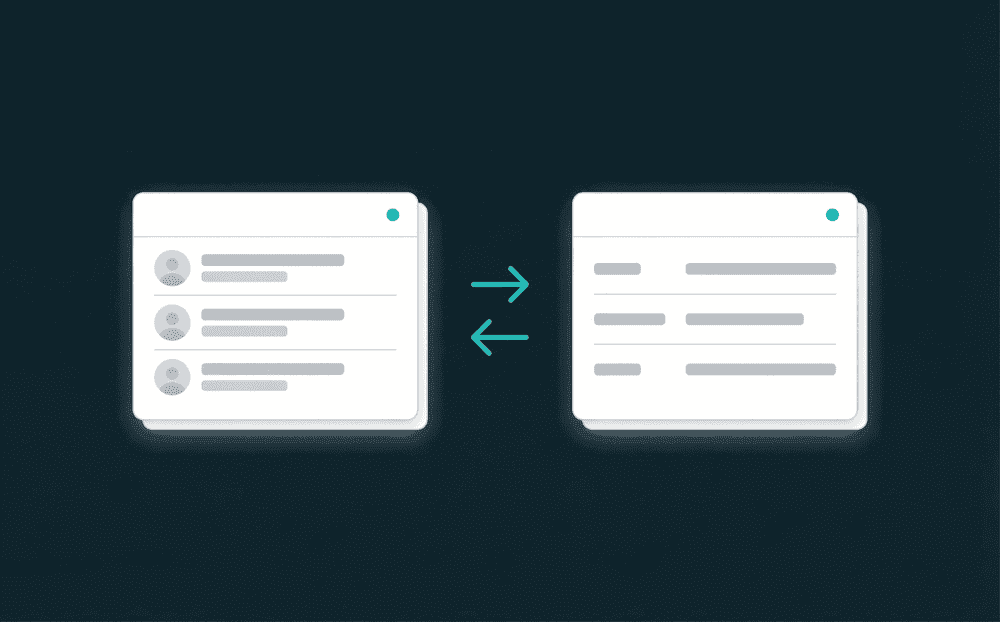
Every Oneprofile connector reads and writes. Sync your database to HubSpot and HubSpot back to your database with the same integration. Airbyte and Informatica separate sources from destinations. Moving data in both directions means building and maintaining two pipelines instead of one.
Is Airbyte or Informatica better for small teams?
How does airbyte vs informatica pricing compare?
Can Airbyte handle enterprise-scale data volumes?
Does Informatica support open-source deployment?
What happens to Informatica now that it is part of Salesforce?