What is a customer data platform?
A plain-language guide to CDPs: what they do, when you need one, and when you don't.
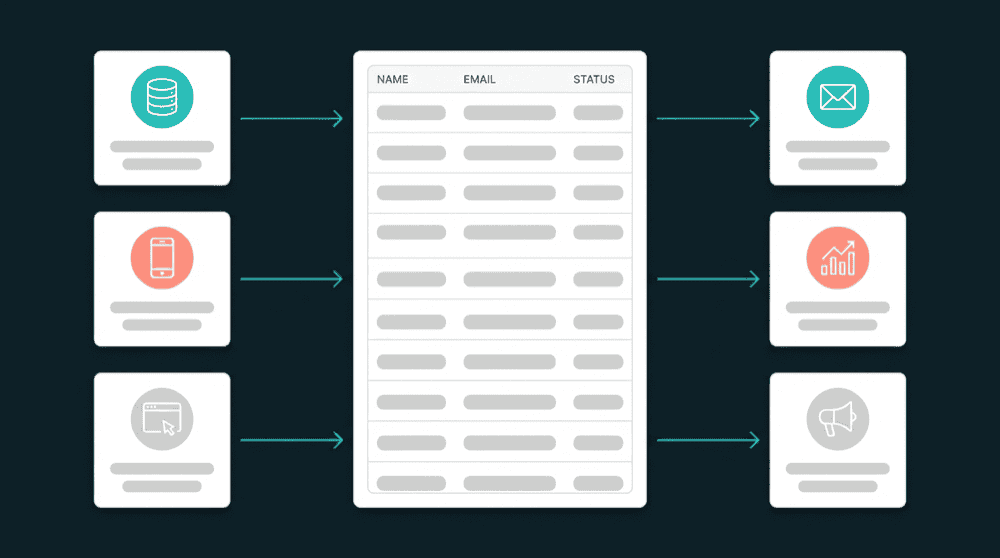
The single customer view, explained
A customer data platform collects customer data from multiple sources, unifies it into a single profile, and makes that profile available to the tools your team uses every day. Your CRM, marketing platform, support desk, analytics, billing. All of them get the same complete picture.
The promise is a "single customer view." Instead of Stripe knowing your customer's billing history, HubSpot knowing their email engagement, and Intercom knowing their support tickets, a CDP brings all of that into one place.
What does a CDP actually do?
CDPs handle three jobs:
1. Collect data. Pull customer data from your tools: billing systems, CRMs, marketing platforms, product analytics, support tools, databases. Some CDPs also collect behavioral data through SDKs embedded in your product.
2. Unify profiles. Match data from different sources to the same person using email, user ID, or other identifiers. This is called identity resolution. The result is one profile per customer with data from every connected tool.
3. Activate data. Send unified profiles back to your tools so teams can act on them. Your sales team sees support history in the CRM. Your marketing platform knows which plan a customer is on. Your support desk shows billing status.
CDP vs ETL vs reverse ETL vs data warehouse
These terms overlap and confuse people. Here is the difference:
ETL (Extract, Transform, Load) moves data from sources into a data warehouse. Tools like Fivetran and Stitch do this. The data lands in a warehouse (Snowflake, BigQuery, Redshift) where analysts can query it.
Reverse ETL moves data from a data warehouse back into your tools. Hightouch and Census do this. You write a SQL query, and the results sync to your CRM or marketing platform.
A data warehouse stores data. It does not sync data between tools, resolve identities, or push data to where teams need it.
A CDP combines collection, unification, and activation. Traditional CDPs (Segment, mParticle, Treasure Data) are standalone platforms. Composable CDPs (Hightouch) sit on top of your warehouse. Both aim to give you a single customer view.
Where Oneprofile fits: Oneprofile is a CDP designed for teams of every size. It connects your tools, resolves customer identities using deterministic matching, builds unified customer profiles, and lets you create and activate audience segments. No warehouse, no SDK instrumentation, no sales calls. Connect your database as the source of truth and Oneprofile pushes data to every SaaS tool in your stack: CRM, marketing, support, billing. If you need your Stripe billing data in HubSpot and your Intercom conversations in PostgreSQL, Oneprofile handles that without a warehouse in the middle. No custom scripts, no webhooks, no cron jobs to keep everything in sync.
When you need an enterprise CDP
An enterprise CDP makes sense when you have:
Millions of users generating behavioral data you need to collect via client-side SDKs
Probabilistic identity resolution spanning anonymous visitors, multiple devices, and offline touchpoints
An existing data warehouse you want to activate (composable CDPs like Hightouch)
Journey orchestration for complex multi-step campaign flows
A dedicated data team to manage schemas, tracking plans, and SQL queries
Enterprise CDPs cost $50,000 to $500,000+ per year and take weeks to months to implement. They are powerful, but they solve problems most teams under 200 people do not have yet.
When you need an accessible CDP
Most small and mid-size teams need CDP capabilities (unified profiles, identity resolution, segmentation) but don't need enterprise complexity. If your goals are:
Keep your CRM updated with billing and support data
Build a single view of every customer across all your tools
Segment customers based on properties, actions, or funnels
Sync audiences to your marketing, sales, and support tools automatically
Replace brittle Zapier or Make automations with reliable sync
Replace the custom scripts, cron jobs, and webhook handlers you have been maintaining
Then Oneprofile delivers these CDP capabilities in minutes, not months. No warehouse, no SDK instrumentation, no SQL queries, no six-figure contract.
How Oneprofile compares
Oneprofile is a CDP designed for teams of every size. It solves the problem most teams actually have: connecting their tools, building a single view of every customer, and keeping data flowing. No enterprise complexity required.
A CDP that works with your existing database. Connect Postgres or any database as your source of truth and push data to every SaaS tool in your stack. No SDK, no event tracking code.
Unified customer profiles. Bring together data from every connected tool into a single profile. See the full picture of every customer without building a warehouse or writing SQL.
Deterministic identity resolution. Match customer records across tools using email, phone, user ID, or any explicit identifier. Configurable matching rules per integration.
Audience segmentation. Build segments using property filters, action-based rules, or funnel sequences. Sync segments to any connected tool as audiences automatically.
100+ integrations, all bidirectional. Every connector can read and write.
No silent failures. When a record fails to sync, you see exactly which record and why. Retry with one click.
Published pricing starting at $0/mo. No sales calls, no enterprise contracts required.
For teams that need probabilistic cross-device identity stitching, client-side event tracking SDKs, or journey orchestration, an enterprise CDP like Segment or mParticle may be a better fit.
FAQ
Is Oneprofile a CDP?
What is the difference between a CDP and a data warehouse?
How much does a CDP cost?
Do I need a data warehouse to use Oneprofile?
When should I choose an enterprise CDP over Oneprofile?
Can Oneprofile replace Segment or mParticle?