Segment vs RudderStack: which data platform fits your team?
CDP Comparison
Segment vs RudderStack: which data platform fits your team?
Polished event collection vs. open-source warehouse-native infrastructure. Both require SDKs and target technical teams.
What Segment and RudderStack do as data platforms
Both collect customer events and route them to downstream tools. Segment hosts the data for you. RudderStack sends everything through your own warehouse.

RudderStack
RudderStack is an open-source customer data platform launched in 2019 as a warehouse-native alternative to Segment. It handles event collection, identity resolution, and data routing, but the core design decision is that your warehouse is the primary data store. RudderStack targets data engineering teams who want to self-host, inspect, and extend their customer data infrastructure.

Segment
Segment is a customer data platform owned by Twilio. It captures behavioral events through client-side and server-side SDKs, resolves identities across devices, and routes profiles to 700+ downstream destinations. The platform is one of the most widely adopted CDPs, with a polished developer experience and the largest integration ecosystem in the category.
Segment vs RudderStack feature and pricing comparison
How these two data platforms compare on architecture, pricing, connectors, and setup complexity.
RudderStack
Segment
Architecture
Open-source, warehouse-native. Your warehouse is the data store.
Managed SaaS CDP. Data stored in Segment's infrastructure.
Data collection
JavaScript, mobile, and server SDKs. Warehouse event streams.
Client-side JS, server-side SDKs, Protocols schema validation.
Integration count
200+ integrations (sources + destinations)
700+ destinations, 450+ sources
Set up time
Yes (deterministic, graph-based)
Yes (Segment Unify, deterministic)
Identity resolution
Required. Warehouse is the core data layer.
Optional. Warehouses supported as destinations.
Warehouse requirement
Free tier (250k events/mo) and Starter ($220/mo) published. Growth needs sales.
Free tier (1,000 MTUs). Paid tiers require sales.
Self-serve signup
Free and Starter are self-serve. Growth and enterprise need sales.
Free and Starter are self-serve. Growth and enterprise need sales.
Open source
Yes (AGPL core, enterprise features proprietary)
No
Audience building
Limited. Audience tools are underdeveloped.
Engage add-on with separate pricing.
Target buyer
Data engineering teams
Mid-market to enterprise engineering teams
Segment vs RudderStack strengths and limitations
RudderStack
Segment
Open-source with full pipeline control
Self-host the core platform and inspect every component. Data engineers can extend connectors, customize transformations, and own the entire pipeline without vendor lock-in.
Largest integration ecosystem
700+ total integrations across sources and destinations. The breadth means most SaaS tools already have a pre-built, maintained Segment connector.
Warehouse-native data ownership
All customer data lives in your warehouse, not a proprietary store. Your dbt models and SQL queries work directly against the raw event data. No migration risk if you switch tools.
Polished developer experience
Tracking plans, Protocols validation, per-destination documentation, and a well-designed API. Developer onboarding is straightforward and well-supported.
Full-stack collection through activation
Covers event collection, identity resolution, warehouse loading, and reverse ETL in one platform. No need to stitch together three or four vendors to build the full pipeline.
Free tier for startups
The free plan (1,000 MTUs, 2 sources) lets small teams start collecting events without a sales conversation. Few CDPs offer any self-serve entry point.
Steep learning curve
Built for data engineers, not ops teams or marketers. SDK instrumentation, warehouse configuration, and config-as-code workflows require technical depth most small teams lack.
Opaque paid pricing
Team and Business plan pricing requires contacting sales. MTU-based billing penalizes anonymous traffic and can spike unpredictably as your product grows.
Warehouse is a hard prerequisite
The architecture requires a running data warehouse. Teams without Snowflake or BigQuery need to provision and maintain one before using the platform's core features.
Inflexible data schema
Segment's data model is rigid. Custom objects and non-standard entity types are difficult to represent, which limits how complex data can map through the platform.
Our Suggestions
Choose RudderStack if you want open-source infrastructure, full pipeline control, and your warehouse as the single source of truth.
Choose Segment if you need the largest integration ecosystem and a polished, managed CDP experience.
Neither one of them feels right to you?
For teams that want to sync tools directly — warehouse optional — Oneprofile offers published pricing, no SDK, and no infrastructure prerequisites.
How Oneprofile fills that gap
You get tool-to-tool sync — warehouse optional — without SDK instrumentation and without a sales call. Authenticate, map fields, and data flows.
Difference 1
Warehouse optional
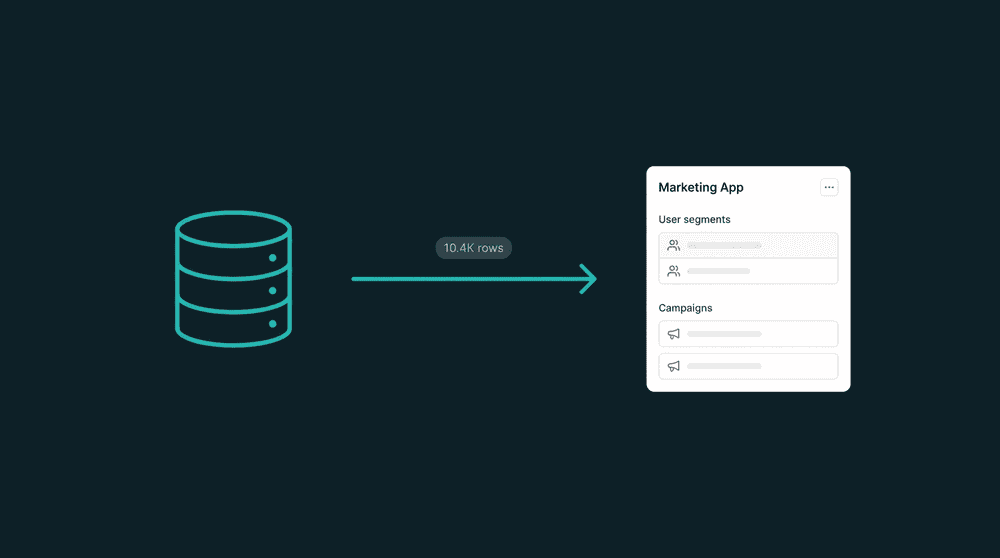
Oneprofile syncs data between your database and SaaS tools directly. No Snowflake or BigQuery required in the middle, though it works alongside them. Your existing Postgres or MySQL is the source of truth, and data flows to HubSpot, Intercom, Mailchimp, or wherever your team works.
Difference 2
No SDK, no tracking plan
Oneprofile connects through API keys. No client-side JavaScript, no mobile SDK integration, no tracking plan to design and maintain. Connect a tool, pick record types, map fields, and data starts flowing. Most teams finish setup in minutes.
Difference 3
Published pricing at every tier
Free tier, $100/mo Team, $2,000/mo Enterprise. All on the website, all purchasable through Stripe checkout. No sales call at any tier. No MTU billing that punishes anonymous traffic. No consumption credits to forecast.
Is Segment or RudderStack better for a small team?
Does RudderStack require a data warehouse?
Can I switch from Segment to RudderStack?
Is RudderStack really free and open source?
What does Oneprofile lack compared to Segment and RudderStack?