Airbyte vs Talend: open-source agility or enterprise ETL muscle?
ETL Comparison
Airbyte vs Talend: open-source agility or enterprise ETL muscle?
One is open-source and batch-only. The other is enterprise ETL with opaque licensing. Both need a warehouse.
What Airbyte and Talend do as data integration platforms
Both extract data from sources and load it into warehouses or databases. They differ in architecture, pricing, and control over transformations.

Airbyte
Airbyte is an open-source data integration platform that extracts data from 600+ listed sources and loads it into warehouses and databases. Founded in 2020, the platform can run self-hosted or as a cloud service. Airbyte focuses on the EL (extract, load) portion of the pipeline, leaving transformations to tools like dbt running inside your warehouse.

Talend
Talend is an enterprise ETL platform now owned by Qlik after their 2023 acquisition. Unlike EL-only tools, Talend handles extraction, transformation, and loading in a single platform through its Data Fabric product. The company originally built its community on Talend Open Studio, a free edition that Qlik discontinued in 2024.
Airbyte vs Talend feature and pricing comparison
How they compare on deployment, connectors, pricing, and the architectural choices that shape your data stack.
Airbyte
Talend
Primary approach
Open-source EL (extract, load). Transforms via dbt in the warehouse.
Enterprise ETL with built-in transformations, data quality, and governance.
Connector count
600+ connectors across Certified and Community tiers
50+ managed connectors; 1,000+ API connections claimed
Pricing model
Around $10/GB database, $15 per million rows API. Free open-source edition.
Opaque. Volume, job count, and duration-based tiers. Sales quote required.
Set up time
Self-hosted, cloud, or hybrid. Single codebase across all.
On-premises, private cloud, public cloud.
Deployment options
dbt Cloud integration only. No in-flight transforms.
Visual tMap transformations, SQL functions, dbt integration.
Transformation support
Batch only. 1-hour minimum on Cloud, 5 minutes self-hosted.
CDC and streaming supported. Limited scale at high volumes.
Open-source availability
Yes. Full self-hosted deployment with source code access.
Yes. Full self-hosted deployment with source code access.
Learning curve
Moderate for Cloud. Steeper for self-hosted operations.
Steep. Java-based architecture requires specialized training.
Warehouse requirement
Yes. Loads into warehouses or databases.
Yes. Primary workflow is warehouse-centric.
Scalability
Limited. No source scale-out. Memory-bound workers at volume.
Scales with infrastructure but requires bulk mode for large loads.
Strengths and limitations
Airbyte
Talend
Open-source with full self-hosting
Deploy on your own infrastructure, audit the codebase, and eliminate vendor lock-in. Self-hosting also removes the 1-hour minimum sync interval that Airbyte Cloud imposes.
Rich transformation capabilities
Data Fabric handles complex ETL logic with visual mapping, data quality checks, and transformation rules within the pipeline. You transform data before loading, not after.
Lower cost at scale
Volume-based pricing at around $10/GB for databases is easy to budget. The open-source edition runs free on your servers, making it one of the cheapest options for large-volume data movement.
Real-time and batch in one platform
Supports streaming CDC alongside traditional batch processing. Most EL-only tools are batch-only, making Talend a reasonable choice when you need both modes without adding a second tool.
Custom connector development kit
The CDK and AI-assisted builder let teams create connectors for niche sources in hours. Over 1,000 contributors have expanded the ecosystem of 600+ connectors across Certified and Community tiers.
Built-in data quality tools
Profiling, cleansing, and governance ship with the platform. Teams that need to validate data before loading can handle it within the same product rather than adding a separate quality tool.
Batch-only processing
Cloud syncs at 1-hour intervals minimum. Self-hosted drops to 5 minutes, but there is no native streaming. If your use case needs sub-minute latency, Airbyte cannot deliver it.
Open-source edition discontinued
Qlik killed Talend Open Studio in 2024. The free option that built the community is gone. Remaining users must pay for Qlik licensing or migrate to another platform.
Variable connector quality
Certified connectors are Airbyte-maintained, but Community connectors vary in reliability and documentation. Worker memory limits can cause failures under heavy loads.
Opaque pricing with per-user licensing
No public pricing page. Costs scale with data volume, job count, and duration. Per-user licensing penalizes collaboration by charging for every team member who touches the pipeline.
Our Suggestions
Choose Airbyte if you need open-source control, self-hosting flexibility, and predictable per-GB pricing for large data volumes.
Choose Talend if you need rich in-pipeline transformations, data quality tools, and real-time CDC in an enterprise ETL platform.
Neither one of them feels right to you?
If you just need your SaaS tools sharing data — warehouse optional — without an ETL pipeline or data engineering team, Oneprofile syncs tools directly with published pricing and self-serve signup.
How Oneprofile fills that gap
Direct tool-to-tool sync with published pricing, self-serve signup, and no ETL pipeline to manage. Warehouse optional. Most teams are live in minutes.
Difference 1
Warehouse optional, no pipeline
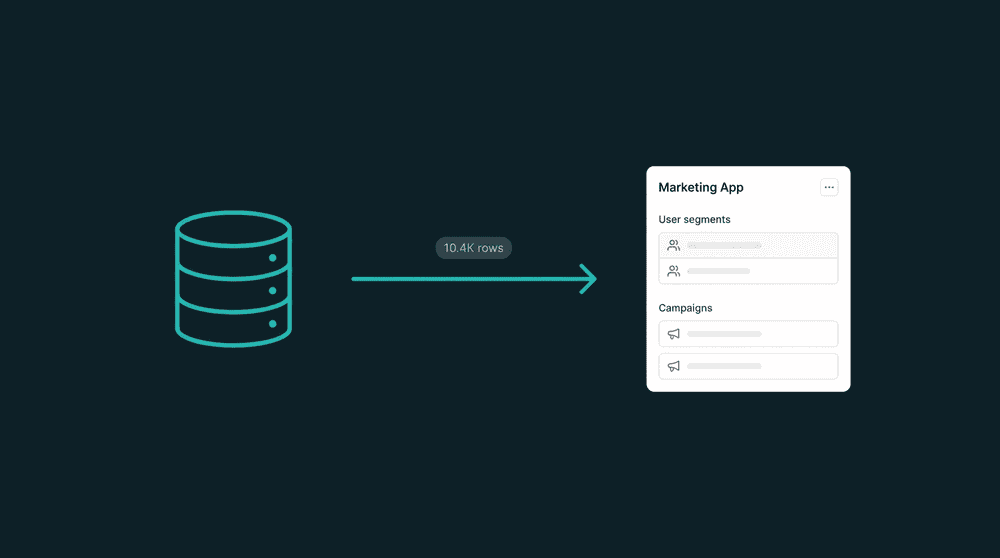
Most data integration tools route data through a warehouse: extract it, transform it, load it, then build a second pipeline to push it back to the tools your team actually uses. Oneprofile works with or without a warehouse. Connect your Postgres database or any SaaS tool, map fields to a destination, and data syncs on the schedule you set.
Difference 2
Published pricing at every tier
Free to start, $100/mo Team, $2,000/mo Enterprise. Every tier is published on the website. Pay through Stripe checkout. No per-user licensing or consumption credits to calculate. You know what you'll pay before you sign up.
Difference 3
Bidirectional sync by default
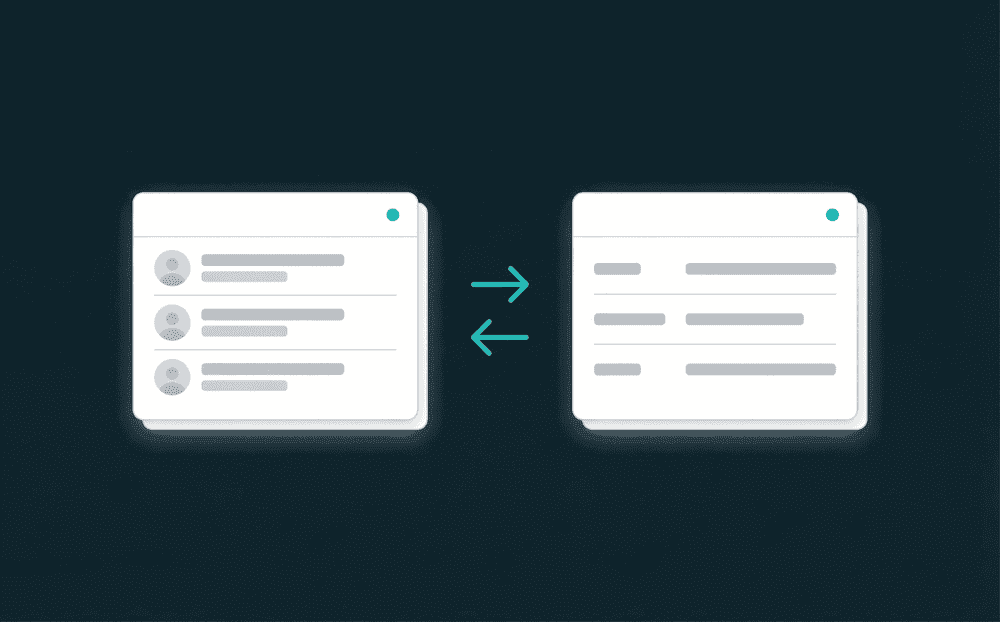
Every Oneprofile connector reads and writes. Sync your database to HubSpot and HubSpot back to your database with the same integration. Traditional data integration tools separate sources from destinations into different connector types, requiring two pipelines for bidirectional data flow. Oneprofile handles it in one.
Is Airbyte or Talend better for small teams?
Can Airbyte replace Talend for ETL?
Does Talend still have an open-source version?
How does airbyte vs talend pricing compare?
Can I use Airbyte or Talend without a data warehouse?