mParticle vs RudderStack: mobile CDP or warehouse-native platform?
CDP Comparison
mParticle vs RudderStack: mobile CDP or warehouse-native platform?
One serves mobile marketers, the other data engineers. Both use SDKs, but only mParticle keeps pricing behind sales.
What mParticle and RudderStack do as CDPs
Both collect customer events, resolve identities, and route data downstream. They differ on who they're built for and where data lives.

mParticle
mParticle is a customer data platform built for mobile-first companies. Founded in 2013 and acquired by Rokt in early 2025 (now mParticle by Rokt), it began as a mobile SDK for event collection on iOS and Android, then added identity resolution and audience management. It is used mainly by large enterprise brands in retail, media, and finance that need cross-device profiles rooted in app behavior.

RudderStack
Launched in 2019 as a warehouse-native alternative to Segment, RudderStack handles event collection, identity resolution, and data routing with your own warehouse as the primary data store. The platform is open-source (AGPL core) and targets data engineering teams who want to self-host, inspect, and extend their customer data infrastructure without vendor lock-in.
mParticle vs RudderStack feature and pricing comparison
How they stack up on architecture, data ownership, pricing, and the kind of team each platform requires.
mParticle
RudderStack
Architecture
Managed SaaS CDP. Data stored in mParticle's cloud.
Open-source, warehouse-native. Your warehouse is the data store.
Primary focus
Mobile event collection and audience management
Event pipeline with warehouse as single source of truth
Data collection
Native mobile SDKs, web SDK, server-to-server APIs
JavaScript, mobile, and server SDKs. Warehouse event streams.
Set up time
IDSync with deterministic + probabilistic matching
Deterministic, graph-based identity resolution
Identity resolution
Built-in audience management with real-time segmentation
Limited. Audience tools are underdeveloped.
Audience building
Data stored in mParticle's infrastructure
Data lives in your own warehouse
Pricing transparency
No public pricing. Contact sales for all plans.
No public pricing. Contact sales for all plans.
Self-serve signup
No self-serve. Demo required for every plan.
Self-serve for free and Starter tiers. Growth and enterprise need sales.
Open source
No
Yes (AGPL core, enterprise features proprietary)
Target buyer
Marketers and product teams at enterprise brands
Data engineering teams at mid-market and enterprise
Strengths and limitations
mParticle
RudderStack
Deep mobile SDK support
Native iOS and Android SDKs are lightweight and battle-tested at scale. For companies where the core product is a mobile app, mParticle's SDK quality is a genuine advantage over most CDPs.
Open-source with full pipeline control
Self-host the core platform and inspect every component. Data engineers can extend connectors, write custom transformations, and own the entire pipeline without vendor lock-in.
Built-in audience management
Audience segmentation, real-time computation, and activation ship with the core product. No add-on pricing, no third-party tool, no separate contract to get basic segmentation working.
Warehouse-native data ownership
All customer data lives in your warehouse, not a vendor's cloud. Your dbt models and SQL queries work directly on the raw event data. If you switch tools, the data stays.
Marketer-friendly interface
The UI is designed for product and marketing teams, not data engineers. Non-technical users can build audiences and configure integrations without writing code or SQL.
Full-stack event pipeline
Covers event collection, identity resolution, warehouse loading, and reverse ETL in one platform. No need to stitch together three or four separate vendors to build the full data pipeline.
Inflexible data schema
mParticle's data model cannot represent custom objects or non-standard entity types. If your data doesn't fit the predefined user-event schema, you'll hit walls quickly.
Warehouse is a hard prerequisite
The architecture requires a running Snowflake, BigQuery, or Postgres warehouse. Teams without warehouse infrastructure need to provision and maintain one before using core features.
No public pricing or self-serve
Every plan requires a sales conversation and contract negotiation. Consumption-credit pricing makes it difficult to predict costs before committing to an annual deal.
Built for data engineers, not ops teams
SDK instrumentation, warehouse configuration, and config-as-code workflows require technical depth. Audience tools are underdeveloped and the learning curve is steep for non-engineers.
Our Suggestions
Choose mParticle if you need enterprise-grade mobile SDK support and built-in audience management for a large brand.
Choose RudderStack if you want open-source infrastructure with your warehouse as the single source of truth.
Neither one of them feels right to you?
For teams that need their tools sharing data without SDK instrumentation or sales cycles — warehouse optional — Oneprofile is a simpler, more affordable path.
How Oneprofile fills that gap
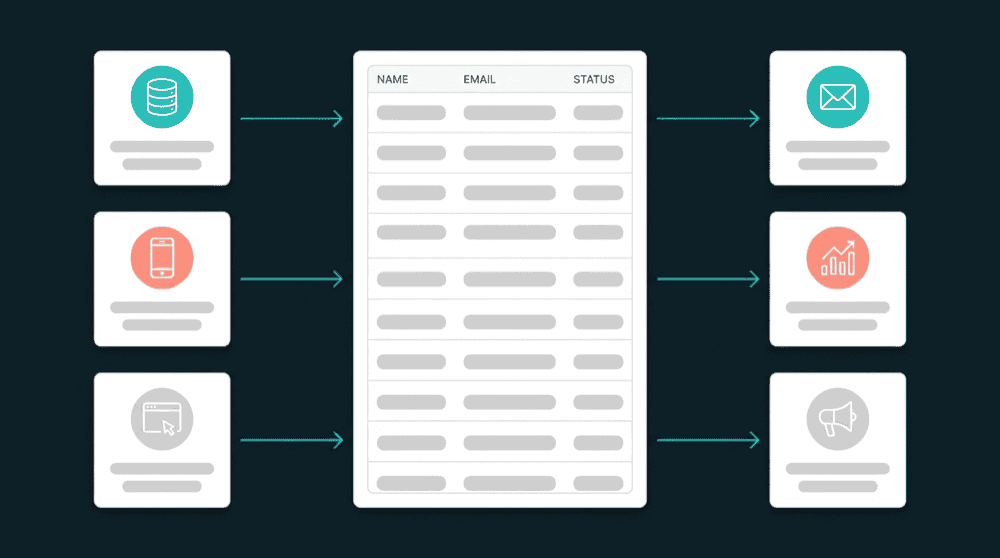
Tool-to-tool sync with API-key auth, published pricing at every tier, no SDK prerequisites, and warehouse optional. Most teams go live on day one.
Difference 1
No SDK, warehouse optional
Oneprofile connects to your tools through API keys. No mobile SDK integration, no tracking plan to maintain, and warehouse optional — it works natively with warehouses but does not require one. Authenticate a tool, pick record types, map fields, and data flows. Teams get live in minutes, not weeks.
Difference 2
Published pricing, self-serve signup
Free tier, $100/mo Team, $2,000/mo Enterprise. All published on the website, all purchasable through Stripe checkout. No sales calls at any tier, no consumption credits to forecast, no annual commitment required.
Difference 3
Your data stays in your infrastructure
Oneprofile reads from and writes to your existing tools and databases without copying customer data into a separate cloud. Your Postgres stays your source of truth. We connect to it, not replace it. mParticle stores data in its own infrastructure. RudderStack requires you to run a warehouse. Oneprofile works with or without one.
Is mParticle or RudderStack better for a small team?
Does RudderStack require a data warehouse?
Can mParticle handle custom objects?
How does mParticle vs RudderStack pricing work?
What does Oneprofile lack compared to mParticle and RudderStack?