Oneprofile vs Make: Data Sync, Not Scenarios
Oneprofile vs Make: data sync without scenario builders
Make builds visual automation scenarios. Oneprofile maps fields and syncs your tools. Here is when each one fits.
Oneprofile vs Make: what each platform does
Oneprofile syncs data between tools. Make automates multi-step scenarios with visual workflows. They overlap where teams use Make for simple data movement.


Oneprofile vs Make feature comparison
Side-by-side comparison of the features that matter when choosing between these two tools.
Oneprofile
Make
Pricing model
Published: $0 free (100K syncs), $100/mo Team (1M syncs), $2,000/mo Enterprise (5M syncs)
Credit-based: free ~1,000 credits/mo, Core $12/mo, scales with operations run
Bidirectional sync
Native. Every connector reads and writes.
No. Requires two scenarios with custom deduplication.
Setup approach
Connect tools, map fields, set schedule
Build visual scenario flowcharts with modules
Field-level change tracking
Yes, tracks old and new values per field
No. Fires on triggers, sends full record payload.
Error recovery
Failed records captured with error details for retry
Requires custom error-handler modules per scenario
Conditional logic
No. Data sync only.
Yes. Routers, filters, if/then branching per scenario.
App count
100+ bidirectional integrations
1,800+ app connections
Historical backfill
Yes. First run syncs all existing records.
No. Only processes events after scenario activation.
Sync modes
Update, Update or Create, Create Only, Mirror
Trigger to action (one-way per scenario path)
Learning curve
Minimal. Connect tools, map fields, done.
Moderate. Visual builder with modules, variables, iterators.
Strengths and limitations
Oneprofile
Make
No per-source or per-destination fees
Free tier to start, $100/mo for teams with unlimited integrations and sync configs. 1M sync actions included — most teams never hit overage. Transparent overage at $200 per million if you do.
Visual scenario builder
Drag-and-drop flowchart editor with routers, filters, and branching. Teams can see their entire automation logic visually, which makes complex multi-step workflows easier to debug and maintain.
No scenario builder required
Connect two tools, map fields between them, set a schedule. No flowchart to design, no modules to configure, no variables to route. Most teams are syncing data within an hour.
HTTP and developer modules
Built-in HTTP modules let teams connect to any API, even without a pre-built integration. JSON parsing, text manipulation, and iterator modules add developer-grade flexibility.
Bidirectional sync by default
Every connector reads and writes. Sync data between two tools in both directions from a single configuration. No update loops, no duplicate scenarios.
Lower entry price for light use
The Core plan starts at $12/mo and a free tier includes roughly 1,000 credits a month. For teams with lightweight automation needs, Make costs less than most competitors at the entry tier.
No conditional logic or workflow branching
100+ integrations compared to Make's 1,800+. If you rely on niche apps or need custom HTTP endpoints, Make has broader coverage.
Credit-based pricing scales against data sync
Every module in every scenario run consumes a credit. Teams syncing records burn through credits fast, pushing you from the $12 Core plan into higher tiers as volume grows.
Smaller app catalog
100+ integrations compared to Make's 1,800+. If you rely on niche apps or need custom HTTP endpoints, Make has broader coverage.
No native bidirectional sync
Keeping two tools in sync requires two scenarios with custom deduplication logic. Without shared state, update loops and silent overwrites are common side effects.
Our Suggestions
Choose Oneprofile if you need bidirectional data sync between tools with published pricing and no scenario builder overhead.
Choose Make if you need visual multi-step workflows, HTTP modules, or complex conditional routing across 1,800+ apps.
Why teams choose Oneprofile over Make
For teams that hit Make's limits on data sync: credit-based pricing, scenario complexity for simple flows, no bidirectional support, no change tracking.
Difference 1
Generous included volume replaces credit billing
Make charges credits per operation, and a five-module scenario syncing 1,000 records burns 5,000 credits in a single run. Scale that to daily syncs and the bill climbs fast. Oneprofile includes 1M sync actions in the $100/mo Team plan with no per-source or per-destination fees. Overage is $200 per additional million. No calculator spreadsheet to predict your bill.

Difference 2
Connect and map instead of building scenarios
Most teams using Make for data sync maintain a five-module visual scenario to do something simple: read a record from one tool, write it to another. The scenario has a trigger, a search, a router, and an update-or-create action. Using a visual automation builder for that is like opening Photoshop to crop a photo. In Oneprofile, the same result is: connect two tools, map fields, pick a schedule.
Difference 3
Bidirectional sync from a single config
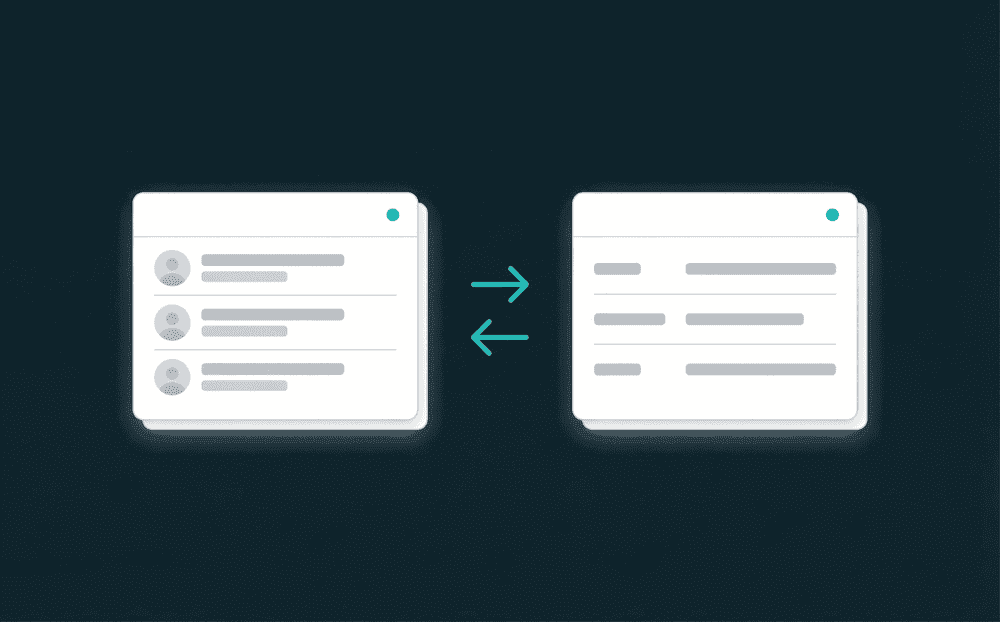
Every Oneprofile connector reads and writes. Syncing HubSpot data to Intercom and Intercom changes back to HubSpot takes one configuration. On Make, the same flow requires two scenarios with no shared state. When Scenario A writes to Intercom, Scenario B detects a change and writes it back. Without custom deduplication, you get infinite loops or silently overwritten fields.

Difference 4
Field-level change tracking
Oneprofile tracks which fields changed with old and new values, then writes only those fields to the destination. Make fires on triggers and sends the full record, overwriting every field regardless of what actually changed. If a sales rep manually edits a CRM field, the next scenario run overwrites it with the source value. Oneprofile skips unchanged fields entirely.
Difference 5
Error recovery without custom modules
When a record fails to sync in Oneprofile, it is captured with the error message, the record data, and a timestamp. You see what failed, why, and can retry it. Make requires adding an error-handler module to each scenario. Without one, failed operations consume your quota and the scenario stops or skips. Adding error handlers to every scenario is manual work that compounds.

Related Content
Can Make do bidirectional sync between two tools?
Is Oneprofile cheaper than Make for syncing data?
Is Make the same as Integromat?
Can I use Oneprofile and Make together?